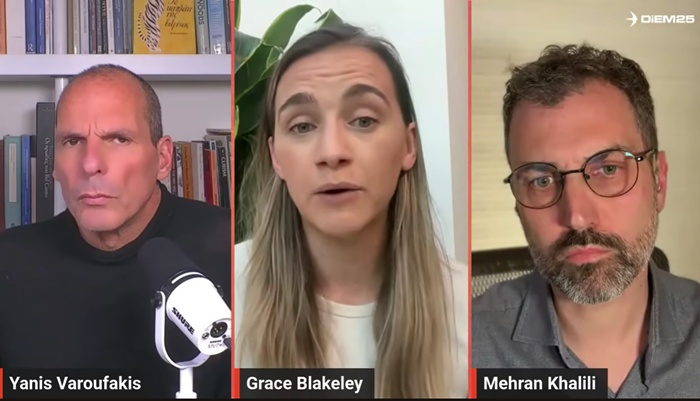
Hello, hello, hello and welcome. I'm Mehran Khalili. We are DieM25, a radical political movement for Europe and this is another live stream with subversive ideas you won't hear anywhere else. And tonight we're discussing the war in Iran.
It's been 19 days since the United States and Israel launched Operation Epic Fury, air strikes that killed Iran's leader, Khomeini, flattened military infrastructure, and opened a war that is still escalating with at least 1,444 civilians killed. The conflict has now spread to Lebanon, where Israel launched a ground invasion yesterday. 50,000 marched in London last weekend and polls show majorities across Europe and America opposed the strikes and yet governments are not moving and the bombs continue to fall.
That gap between public opinion and real political pressure is what we're going to examine here tonight. Not just to diagnose it but also to ask what would it take to close it? What would resistance to this war actually look like from where we are right now?
To answer these critical questions and more, we have, of course, our own Yanis Varoufakis. And I'm delighted to welcome Grace Blakeley, the author of Vulture Capitalism, Substacker. Check out her Substack and also a DM25 coordinating collective member. And of course, we've got you, you out there. If you have thoughts comments, rants, anything you want to throw at us, then put them in the YouTube chat and we'll put them to our panel.
Grace, let me ask you about the anti-war position. As I said in the intro, it really has the numbers and it has what I would think to be a very compelling argument. Why do you think it's failing at the moment to land?
1.56 As you said there's opposition, but that opposition hasn't yet been translated into mass resistance. And I think what's interesting reflecting on this is that you can say the same thing about pretty much every big political crisis that's happened at least over the last 20 years. There's resistance to the cost of living crisis, there's resistance in the pandemic, there's resistance to austerity, resistance to the financial crisis, but, other than outside of a few occasions, that doesn't translate into this wholesale resistance and mass movement that's capable of upending the system.
2.35 If you speak to a lot of people, the received wisdom about this would be it's to do with leadership. It's to do with the need for better and more cohesive political institutions, particularly in majoritarian electoral systems where you've only got two major parties needing to form new political structures.
2.52 Those things are all important but something that I'm writing about and thinking about a lot at the moment because it's the subject of my next book is this issue of individualism and the lack of any impetus to build movements and forms of collective struggle in moments of crisis. Because if you think about the formation of political parties in the past, like the original left political parties, were formed because they emerged out of pre-existing movements, labor movements, social movements that had formed even outside of party political structures.
3.30 The big question that we have today is what's changed? Why is it so much harder to form cohesive political movements inside of or outside of party structures than it was in the past? Such a big thing is that there's been this kind of banishment of the very idea of collective organising from mainstream society. Basically, it's seen as something that you do if you're a bit radical, you go to a protest or you maybe participate in some form of politics. But for a lot of other people, participation in politics is basically limited to voting in elections and liking political posts on Instagram. And this is something that the left has been struggling with even in times that it's been successful because (Yanis, you were a part of this in Greece. I was a part of this in the UK) we've managed to build those political movements capable of kind of channeling that frustration and opposition to the existing system into electoral success. But that hasn't then often translated into a long-term sustained mass movement that's capable of really resisting the stuff that gave rise to all of those issues in the first place. And that's a really hard thing to solve.
4.47 Some of you might have seen that Louis Theroux documentary about the manosphere. That's the right responding to the absence of collective power and collective institutions and basically saying you're on your own. You have to compete to survive. The people who get to the top are the most valuable. Everyone else is a loser. And that's a result of the marketization of society - the dominance of market ideology. The idea that we're all these little isolated individuals competing against one another. I don't think the left has really focused on rebutting that enough.
5:25 Talking to this need for community, this need for solidarity, this need for bigger structures and organizations that can help us feel powerful again, help us channel this anger and frustration and fear into something more positive. I think that's something that's really missing and we can talk about about why that is.
5:50 Mehran: Yanis, what's your take on this? especially with regard to the Iran war. Why is that argument failing to connect?
Yanis:
5.59 Well, Grace, I'm looking forward to reading your book. Maybe I'll become a bit wiser on the failures of collective action.
Mehran, three reasons. First, fatigue. As Grace said, for decades now, we have been managing to put together gigantic demonstrations; none of them were larger than the ones in 2003 opposing the Iraq war. Millions were out on the streets. It was very clear that almost in every country in Europe the opposition to the invasion of Iraq by George W. Bush and Tony Blair and the rest there was overwhelming opposition to that war and yet the demos the many were utterly ignored by the very movements and parties that came out of the demos - like the Labour Party.
7.00 In the last two three years following the genocide, the intensification of the genocide of the Palestinians after October 7th of 2023, I think there is a desperation of the public. We had one demonstration every couple of days for two years. The fatigue gets worse and it is combined with a sense of helplessness. you the the more brutal the machinery of death becomes and the more evident it is on our screens that the genocide is happening, the greater the sense of helplessness that people feel.
7.40 They're demonstrating time and again, yet the BBC, the legacy media, continue to distort the picture continue to find ways of backing the killing machine of the Israelis - now of the United States in Iran. The manner in which the legacy media have papered over the massacre of the school children, the school girls in Iran. I think that creates an intense sensation of helplessness which makes the experiences of 20 years ago against the Iraq war even more debilitating for people.
8.25 Thirdly this is also very important. The fact that we are being asked to demonstrate against the war which is waged against a regime that many of us on the left, let's put it diplomatically, are sceptical, if not in serious opposition to. Two/three years ago we should have been out on the streets supporting the woman life freedom movement in Iran.
9.08 The manosphere, Trumpists, the fascists have very simple message; it's a message of hatred - we hate women, we hate trans, we hate the left. Just very simple, black and white situation. We leftists have to maintain the rage while at the same time being nuanced. In the case of Iran, just like in the case of Yugoslavia back in the 90s with Milosovich, just as in the case of Gaddafi and Libya, in the case of Afghanistan, in the case of Iraq, we have to be able to at the same time hold two different thoughts in our mind. One is that we despise the regimes that are being bombed and at the same time to understand that citizens of the west are committing crimes against humanity in those far far away places. We need to concentrate on one thing - to stop the bombing. It really doesn't matter what we think about the regime in Tehran; in the same way it didn't matter what we thought of Saddam Hussein. The bombing, the invasion, the mass death that our mafia, our governing mafia is imposing upon the people who live under those regimes creates an ethical responsibility for us to stop our killing machine from essentially propping up all sorts of unlikable governments and systems of government in places like Iran by bombing them.
If you are a feminist, if you are a democrat, if you're a socialist, a communist, in Iran you don't have a choice between socialism and theocracy, you don't have a choice between democracy and theocracy. What you are being pushed into choosing is between theocracy and a failed state like Syria or Libya. We must help our comrades in Iran by doing only one thing and that is ending the sanctions that starve the poor and enrich the regime smugglers. Force our governments to dismantle the propaganda machine that tells us that war is peace and occupation is freedom. Only then can the Iranian people exercise their power at home with our help. But this is a very nuanced proposition for us.
It's complicated.
11.31 It needs to be maintained as a complicated project. We don't have the luxury that the extreme fascist right has to just have one tiny stupid little thought in their mind and to be motivated just by that.
Mehran:
11.49 Thanks for that, Yanis. And and to your point about nuance and and simpler messages winning out, I'm looking at this Telegraph article now about the London protest. It was a a stop the war campaigners peace protest yet the headline is "pro-Iranian protesters march through London", that's emblematic of the that kind of coverage. Very clever.
Grace:
12:14 Pro-Iranian in the sense of being for the Iranian people, not pro the Iranian regime. Utterly absurd.
12.28 What Yanis was just saying about helplessness ; I think so many of us feel helplessness sometimes looking at the state of the world, feeling like what on earth can I do about this? I speak to friends who aren't really very political and that sense is very very widespread. I don't think it is necessarily limited to one political ideology. Whether you're on the left or the right, you feel angry about the housing crisis, about the affordability crisis. You're probably angry about the war in Iran because most people are. You're angry about the Epstein files. You're angry about oligarchy, about so many different things. And you feel this sense of hopelessness and powerlessness that you just can't do anything in response because they're such big problems. Our politics and our economy are so concentrated in such a small number of hands that it feels impossible to even imagine how you could confront this.
13.24 I think this is where a lot of the kind of conspiracy theory stuff that you saw coming out during the pandemic stems from. It's this sense - okay, the world is governed by an all powerful elite and they could be lizards, whatever the latest theory is, or Bill Gates putting 5G into our bloodstreams. The reason that those turn into conspiracy theories instead of forming resistance is that sense of powerlessness. The elite, whoever they are, is all powerful and there's nothing I can do about it, other than try and extricate myself from those systems, not get the COVID vaccine, or go and live in the wilderness somewhere.
13.58 The right has a really clear channel for those people. There was that channel of pissed off during the pandemic through to the antivax pipeline, through to the far right. There's that channel for young men who can't get a job, and they go down into that that far right manosphere as a result. People are really angry about all these issues in our society and feel helpless. The message from the far right is to say, "We're building this group for you, and you can feel part of that group, and it will give you a sense of belonging, but also that you'll feel powerful as a result of that, that you'll feel like you have some agency. We're kind of building this like anti-systemic political movement that they frame themselves as or whether it's just taking power back in your family by asserting control over your wife.
What is amazing about the right now is that a lot of people who support right-wing political parties are actually angry about the war in Iran. They're angry about the affordability crisis. They're angry about the Epstein files and often they realize that we do live in this corrupt oligarchy, but that just makes them feel more powerless and therefore more angry.
On the left, there's a couple of different ways you can respond to powerlessness. Basically rage which the right does, or despair which we often do on the left. For those of us who aren't engaged in an active political movement this sense of the world is screwed and there's nothing I can do about it just leads you to despair.
15.32 But there is another option which is to realize that we're not powerless. We don't have as individuals the capacity to bring down this entire system as much as we might want to; but as a movement we do have power, and that power is evident in the entire history of the left from its very origins. It began in conditions that were much harder than what we're facing right now, both for individuals and for the movement as a whole. The question is:-
How do we turn the sense of powerlessness and the sense of anger and this sense of despair into a solid movement? How do we give people back that sense of agency on the left?
16.16 Protest is important in that it provides people with not just an outlet for their anger, but a sense of everyone else is annoyed about this. I'm not on my own in that. And it allows for those kind of links to be built that often form the foundations of future political movements. But there's also so many other creative ways that I've seen resistance happening throughout societies all over the world. One thing that immediately came to mind was that when the genocide was at its peak, I spoke to a few people that were setting up these things called apartheid free zones in their cities where they basically organized to go around to all these different shops and say, "Will you participate in our boycott of Israeli goods?" That became this big movement in a few different cities around the UK, and created a real sense of purpose, community and solidarity that fought back against this idea that we can't do anything to challenge these structures from day to day. Obviously we were also going out and protesting and going to those demonstrations in London all the time and raising these issues within political parties but I think providing people with those ways that they can resist in community together is also really important for combating this idea that I'm all alone, the world is screwed, no one else cares, and there's nothing I can do about it.
Mehran: That's really good. If we can put a pin in that, because I I would love to return back to what we can do - how we can address the gap. But to drill down a bit more at this point in the conversation on some of those structural reasons why the opposition is hampered on specifically around the Iran war.
There were a couple of other reasons that I'd like to throw at you both and you tell me what you think. The first is that this war came about very very quickly - unlike the Iraq war that you mentioned Yanis where there was a whole process of months and months of buildup and UN processes and so on. Now the opposition is basically on the back foot. It just happened even though you could probably predict that it might. It happened on a Saturday morning and there hasn't been time really to organize. I know there are lots of people in the organising community that are having those meetings right now. Those Zoom calls are happening you know as we speak.
A related point on that is that in this new sort of might makes right world, Trump has sidestepped all of those institutions. So there's no UN process to rally anybody around. This means it's quite difficult to call for, to lobby to have all those individual points in the chain where you might actually go; maybe we can do something here. He just took the decision. That's it.
And lastly, the Iranian diaspora. I don't want to call the Iranians one big group - they're absolutely not. But the most vocal group of the Iranian diaspora, of course, amplified by Western media and probably funded by Israeli government, is of course the royalists who are actually with the people who are bombing Iran - with the US and Israel. So that sort of deprives the moral authority, the emotional urgency. It deprives that we don't have that group in the narrative to be able to make that argument. So what do you guys think of those structural reasons? Can you think of any others that are worth kind of expanding on as we try to deconstruct this problem?
Yanis:
20.01 Of all the explanations that you just offered it's an empirical issue whether they are correct or not. My sense is that they're not that significant. The most significant factor in explaining the loss of verve amongst demonstrators is the two and a half years of constant demonstrations against the Gaza genocide; despite the many victories in court, the moral victory of the flotilla, the moral victory of the march to Gaza, and the fact that we were victorious on the ethical plane, that made no difference. On the ground as we speak, children in Gaza being operated upon without anesthetic because Israel is refusing to allow anesthetic into Gaza. That is the sense of helplessness. We've done all that for two and a half years. We've been demonstrating. We've succeeded. We've changed public opinion. Even in the United States public, the needle has shifted. The majority of people now are pro Palestinian compared to pro-Zionist, genocidal and yet nothing is changing they are still wiping the floor clean with the Palestinians. I think that is the most significant part, and it's also something that Grace you alluded to before.
21.32 I will speak from the Greek perspective here because there were many countries in which the movement never came anywhere close to government. Here in Greece we had one of the few experiences where a grassroots movement in 2011 the Greek indignados filled the squares in the hundreds of thousands spontaneously without a political party egging them on. This gave rise to the movement which in the end saw to it that a party of 4% Syriza effectively formed government; and once we got into government our leadership was coopted.
22.15 There are two separate but synergistic sources of emotional fatigue. On the one hand, the idea that we may be hundreds of thousands, we may all feel together equally pissed off with what's going on, but it's not going to stop the the guns and the bombs and the politicians. We're not going to get our hands on the levers of power to change course.
So there is this discontent but there's the other discontent in places where we did manage to get our hands on the levers of power, and the ones who were actually holding the levers of power effectively defected onto the other side. So if you put those two together and you juxtapose this against what's happening amongst the ultra-right where the ultra-right are being weaponized whether they are the manosphere, the fascists, the racists, the Islamophobes. They're being weaponized by a whole system which does have control of the levers of power, and they use it in order to bomb people.
23.24 So the question for me is this. South of where Danae and I are here in Greece, we have a large military base on Crete in Souda. There are aircraft carriers of the United States and there are bombers and so on; similarly, a military base at Ramstein in Germany. Airplanes are leaving from there, they're refueling other aeroplanes, and they are all together bombing into smithereens the Iranian people. In Cyprus, the British base of Akrotiri is being made available by Keir Starmer's government to the Americans and to the Israelis, on the one hand to continue the genocide in Gaza and on the other to bomb the living daylights out of the Iranian people. The question is this, can we begin to imagine our movement effectively shutting these bases down? Winning government and sending a missive to those warmakers, your days are out, your days are gone. You can't take off - not allowing the Americans or the Israelis to use the bases; I'm even saying we are not near doing that. Are we capable of envisioning taking over those leaders of power? If we're not, then I can understand the pessimism.
Mehran:
Okay, Grace, I hand it back to you. I want to give you one other thing to maybe factor in and that's something that you've written about which is the economic consequences of this war landing on ordinary people. There is an argument that people are going to wake up as soon as the economic consequences hit them. Right now considering that there isn't a draft and that things are getting very hairy very quickly people haven't really felt it yet that's why people are inactive. What's your take?
Grace:
25.28 That is what I was going to say. We have won the ethical argument, we won it a very long time ago. There isn't this kind of international fight that we can fight through the UN or whatever. But I think that in focusing on those issues, we were focusing on the wrong things anyway. You know, not that it's not important to fight these ethical battles; it absolutely is. But if we're going to build a mass political movement that's capable of transforming society, winning power within the state, then we need to focus on bread and butter issues. We need to be able to translate the things that we're worried about into issues that resonate with people's everyday lives.
Now, this has always been a challenge for the left when it comes to particularly things like imperialism. If you go back to the original theorists of imperialism, you have Lenin writing about how the working class and the rich world is effectively a labor aristocracy and benefits from exploitation abroad. But it matters how we talk about these things. If we go around saying the working class and the rich world are benefiting from the war in Iran, which I don't think they are, but let's say that we were to say that, that creates a group identity that is therefore not amenable to our movement.
26.47 If we're able to refocus that conversation and start talking about how our elites just corrupt, adventures abroad are screwing over everyone else and making life harder, then you have the basis for a much broader and deeper coalition. It's very easy to do this with this war because it is making life a lot worse for everyone else. I think the way that we do that is by focusing on three major things - affordability, energy, and oligarchy.
The first one is affordability. So I've written a lot about this on my substack already, just what is going to happen to the international economy as a result of the disruption that we're seeing from the Iran war. Yes, oil prices have risen. You know, they've been going up and down; there's been a huge amount of volatility but overall they have risen on the back of a number of different countries shutting down their oil production, on the back of the closure of the straight of Hormuz. But that's kind of just one kind of relatively minor part of this much broader issue. The second issue is of course shortages of liqufied natural gas because Qatar exports a lot of liquified natural gas and obviously shut down the plant that was doing that. But relatedly in the process of the production of LNG you also produce a number of other chemicals that are really important to production of lots of different things particularly fertilizer. So agriculture is being affected right at the time that farmers are supposed to be fertilizing their crops. There's a study that suggests that this is going to lead to rising food prices in the shops within about six weeks as a result of that impact on agriculture and on fertilizers. There's obviously a crisis in global logistics of the kind that we really haven't seen since the pandemic as a result of the closure of the Straight of Hormuz which is going to impact prices on the shops and is going to by the way make massive profits for the extraordinarily consolidated shipping industry which is effectively an oligopoly. That is just two parts of this much broader economic crisis. There's that affordability angle which we really need to focus on just translating like you are going to be seeing higher costs on the shelves and it's because Donald Trump decided to go to war and Keir Starmer was too pathetic to actually mount any proper resistance to that.
29.14 Then there's the energy argument. We keep seeing energy crises that result from the fact that there are a few, often tyrannical, regimes that basically control the world's oil supply of which the US is one by the way as a major fracker. The more we rely on these forms of energy that can be concentrated in a few hands - be those state oil companies like Aramco or be those massive oil multinationals like Exxon Mobile, as long as we rely on energy sources that can be concentrated like that, these crisis are going to keep happening. It's also again worth bearing in mind that we see a systematic relationship between dictatorship and autocracy and oil revenues because if you can rely on oil revenues, you don't need to tax your population as much; look at the Gulf States. That means that relationship between democracy and accountability becomes even more frayed. It's not just the countries that have oil that happen to be the ones that are most unstable. There's an inherent relationship there and renewable energy is more distributed, it's more decentralized. It's much less likely to come under these forms of strain.
30.30 There's affordability energy and finally oligarchy. A few men, powerful men backed by big fossil fuel corporations and a few other people who are in positions of extraordinary power decided to take us all to war and there was no democratic accountability there, and we're all going to be suffering as a result. So I think if we can translate what's going on here into those three issues and then make our arguments on the back of that then we build a much bigger coalition.
BZ - There are other interesting points made but after this zandtao has not quoted them so he has not formatted the transcript.
Mehran:
31.00 Can I ask you something though, Grace?
31:00
31 minutes
Just to push back for a second and then I you on the topic of affordability in energy.
31:06
31 minutes, 6 seconds
Isn't the the the argument that that those in power are going to make? Well,
31:13
31 minutes, 13 seconds
that's look what Iran did. That's this is the cost of it. The sort of Putin's price hike uh argument and and don't and
31:22
31 minutes, 22 seconds
what's the counter what's the counter counterargument to that? Do you see what I mean? Counter people saying that we like that we that people are going to
31:29
31 minutes, 29 seconds
say it's Iran's fault that that all these prices went up and Yeah. Yeah.
31:35
31 minutes, 35 seconds
So I think two I don't think they can even make that argument can they? I mean Iran didn't bomb itself.
31:41
31 minutes, 41 seconds
Yeah. And also I think the energy argument then becomes even more powerful because it's like okay we're giving control over our entire economy to like
31:49
31 minutes, 49 seconds
a few oil producing states so we need to invest in renewables.
31:53
31 minutes, 53 seconds
Okay, let me take further um Grace's uh point. I agree entirely with a trip, the
32:01
32 minutes, 1 second
triangle of affordability, energy oligarchy. Um we do that here in Greece with our party me 25. Uh but I think
32:09
32 minutes, 9 seconds
that it works even better, Grace, if um okay, you say everything I would say everything you said, but then
32:17
32 minutes, 17 seconds
concentrate on things that can change within your own country. take yours, the United Kingdom, because if you start talking to people about, you know, the
32:26
32 minutes, 26 seconds
um oligarchic power of Aramco in Saudi Arabia and the fracking industry in New Mexico and so on, people say, "Yeah, yeah, well, what can we do about that?
32:34
32 minutes, 34 seconds
That's too far away. Can't change Mexico." New Mexico. But if you concentrate on what's happening in your own country and I will use yours as an
32:43
32 minutes, 43 seconds
example, the United Kingdom and if you say to people things that the average Britain does not understand, for
32:49
32 minutes, 49 seconds
instance, that you know every kilowatt hour that is produced of electricity in Britain from u uh wind turbines
32:59
32 minutes, 59 seconds
uh you pay for it. That's what we need to say to people as if it has been produced by the most expensive natur you know liqufied natural gas from New
33:07
33 minutes, 7 seconds
Mexico. This is the target model. Uh and even if we had 99%
33:13
33 minutes, 13 seconds
of our energy produced locally without the use of fossil fuels even if we did with the current market structure we
33:21
33 minutes, 21 seconds
would be paying the same. And this is a scandal because this is something we can change within our country without changing the world without uh deposing
33:30
33 minutes, 30 seconds
you know the the powerful fossil industry fossil fuel industry around the world. We can do it today in Britain. We can do it in Greece. We can do it in Germany. But why are we not doing it?
33:40
33 minutes, 40 seconds
We're not doing it because uh convinced our society that we need a market for electricity when we don't really know. There can be no such thing
33:49
33 minutes, 49 seconds
as a market for electricity. It's all a fake market. It's a quasi pseudo market.
33:54
33 minutes, 54 seconds
There's only one bloody wire that comes out of the wall in your home, in your shop. Okay? You don't choose between 50 different companies. It's a fake market.
34:02
34 minutes, 2 seconds
It is a simulated market, which is a cartel. And the purpose of which is to make sure that you pay not um a certain
34:11
34 minutes, 11 seconds
amount in excess of uh the average cost of electricity, but that you pay huge
34:18
34 minutes, 18 seconds
margins. And in the end, every single kilowatt hour is being paid for at a
34:26
34 minutes, 26 seconds
rate determined by the most expensive kilowatt hour ever produced, which is exactly the opposite of even what, you know, neoliberals should be interested in. And you see, you simply say to them,
34:36
34 minutes, 36 seconds
look, we can do this today here in our country. We blow up these stupid um uh electricity markets which don't really
34:44
34 minutes, 44 seconds
exist. They don't operate like the market for for you know meat and for beer and for bread you know the baker
34:52
34 minutes, 52 seconds
the brewer and the butcher Adam Smiths this is all got nothing to do with even liberalism what we have we have an oligarchy which is sitting on our on our
35:01
35 minutes, 1 second
shoulders and it is sucking the you know the blood out of us and here is what we could do today blow up the electricity
35:08
35 minutes, 8 seconds
markets replace them by a socialized system of producing and distributing electricity And then you will have a reason why
35:16
35 minutes, 16 seconds
people will want more renewables because the more renewables they have the lower the cost and the lower the cost the lower the price. Today that is not the
35:23
35 minutes, 23 seconds
case. Even if you you know sort of increase by 30% the percentage of kilowatt hours that are being produced
35:30
35 minutes, 30 seconds
in and distributed in Britain um from renewables you you know people will be paying the same and they will be you
35:38
35 minutes, 38 seconds
know essentially sponsoring the same oligarchy. So combine oligarchy with energy and bring it down to the ground
35:45
35 minutes, 45 seconds
to your own country to say that you know we don't need to have world socialism before things can change in our country.
35:53
35 minutes, 53 seconds
We could change it to today and then get them angry that it is not changing today. Whereas if you start bringing in you know an international scene then you
36:00
36 minutes
say well you know we're too small a country to change the international scene.
36:04
36 minutes, 4 seconds
Thank you Janice. Allow me to read out a couple of comments from the chat. SV Harkin says that the effect on energy is not a bug of the war, it's the feature.
36:16
36 minutes, 16 seconds
And Luis Almis continues this theme. He says some have argued that the USA is actually fighting this war to rail raise
36:23
36 minutes, 23 seconds
oil prices. The USA is an oil and gas exporter, not importer. Evie says the highest price of this war is the
36:29
36 minutes, 29 seconds
environmental one. And Spiffy Keen notes that the position of the elite is much more precarious than we think. it is
36:37
36 minutes, 37 seconds
predicated on the complacency of the masses that they exploit. So, as I head it back to you, Grace, um I I really
36:45
36 minutes, 45 seconds
want to continue this sort of what can we do, and there's some really good ideas that are being thrown around here. Um but I also want to look at Spain.
36:54
36 minutes, 54 seconds
Now, Spain is being held up in some circles uh as the model. The Spanish prime minister, as I'm sure we all know,
37:02
37 minutes, 2 seconds
he told Trump where to stick it on on Iran. The new statesman has profiled him now as a left-wing icon. Janice, I know
37:10
37 minutes, 10 seconds
that in our private discussions, you've said that this was there's a lot of political he was doing it for political reasons. Nonetheless, could this
37:18
37 minutes, 18 seconds
potentially be uh a model that we can when when there is this anti-war movement, which I'm sure is coming and
37:27
37 minutes, 27 seconds
about to storm the gates, call for look to emulate, adapt. What do you think, Grace? than you.
37:34
37 minutes, 34 seconds
Yeah. I mean, well, what you just said is is really powerful, right? Which is that he's done a lot of this stuff for political reasons. What does that mean?
37:41
37 minutes, 41 seconds
It means that he knows that there is a mass organized base within Spanish society who were extremely pissed off about what went on in Gaza, extremely pissed off about the war in Iran,
37:50
37 minutes, 50 seconds
generally progressive on the economy,
37:53
37 minutes, 53 seconds
and that they are powerful enough as an electoral force to influence the decisions made by those at the very top of society. That's the situation we
38:01
38 minutes, 1 second
want. you know, we can't just expect to have amazing leaders who are always going to make the right decision without any pressure. The point is the pressure.
38:09
38 minutes, 9 seconds
The point is that they should feel under that pressure and therefore pushed to make uh to make those decisions. So, I think that's actually in some ways a
38:17
38 minutes, 17 seconds
good example. It's not that we have to have wonderful extremely left-wing leaders. It's that we have to have those political structures that can force them to act in the interests of the majority.
38:27
38 minutes, 27 seconds
And that's that important then kind of dialectical relationship I guess between parties and leaders and and wider society. Um I actually wanted to speak a
38:35
38 minutes, 35 seconds
little bit to the point made by one of the commenters which was has the US launched this war in order to raise
38:42
38 minutes, 42 seconds
global oil prices. I've heard this a lot recently, both from people, often from Trump supporters actually, saying he's
38:50
38 minutes, 50 seconds
done this on purpose to screw over China or, you know, he's done it to benefit uh US frackers, right? Either way, the idea
38:58
38 minutes, 58 seconds
is that it was intentional to raise oil prices. I don't think that you can read this conflict that way because the immediate impact has been a huge crisis
39:07
39 minutes, 7 seconds
for Trump directly as a result of the affordability issues that are being caused by rising oil prices. Trump has
39:14
39 minutes, 14 seconds
been pincered by affordability um for a long time and then recently obviously Epstein has come in as well. I
39:22
39 minutes, 22 seconds
saw a poll today that said that about half of Americans think that he started this war to distract from the Epstein files. I'm not sure that the the
39:30
39 minutes, 30 seconds
relationship is that direct, but what is very clear is that this for him I would say is a kind of Thatcher Falkland's moment which is to say that he's
39:39
39 minutes, 39 seconds
launched a war to project strength at a point of weakness for him and his regime at home and that domestic vulnerability
39:48
39 minutes, 48 seconds
is I think linked to yes Epstein oligarchy all of those issues but also the affordability crisis which has been going on for a very long time now before
39:56
39 minutes, 56 seconds
this um war even started uh I wrote a piece looking at um what was really going on in the US economy and there were a few stats that really stood out.
40:07
40 minutes, 7 seconds
The first was obviously that without AI investment one Harvard economist estimated that US GDP would have grown by like 0.1% that it was basically flat.
40:15
40 minutes, 15 seconds
The second was that 50% of consumption was accounted for by the top 10% of consumers. So the wealthy, the spending
40:23
40 minutes, 23 seconds
of the wealthy and the AI boom is basically keeping the economy afloat.
40:27
40 minutes, 27 seconds
And those two things are related because um 10% of Americans own about 90% of the country's stock wealth and that big boom
40:35
40 minutes, 35 seconds
in share prices has just made them feel wealthier. At the bottom end of the income spectrum, the stat was that around a third of Americans were
40:44
40 minutes, 44 seconds
spending more than they were earning every month and covering the difference with debt. that credit card debt has increased substantially and all sorts of
40:51
40 minutes, 51 seconds
different indicators of financial distress were kind of flashing red even before this crisis. So the affordability issue which Trump promised to solve is
41:00
41 minutes
still raging. Oligarchy is still alive and well. Inequality is getting worse.
41:05
41 minutes, 5 seconds
and he knows that this week he's just they've just passed a bill banning um real estate companies, big developers
41:14
41 minutes, 14 seconds
from buying up uh individual family homes. And this was again part of his thing, an allegedly leftwing move, a kind of symbolic move to say we care
41:22
41 minutes, 22 seconds
about the affordability crisis. I honestly think the affordability crisis is for Trump one of the biggest things that he's worried about right now just
41:30
41 minutes, 30 seconds
given where his base is at and given how betrayed they feel about the fact that things are getting more expensive and their lives keep getting worse and for that reason I don't actually think this
41:39
41 minutes, 39 seconds
was intentional and I do therefore think it's something that we can we can mobilize on. Thanks Grace. Was it intentional?
41:47
41 minutes, 47 seconds
Yeah. Well, on Sanchez, he's doing the right thing. So, we should applaud him and not necessarily celebrate him, but applaud him and support him. Uh, I wish
41:56
41 minutes, 56 seconds
I could agree with you, Grace, that he's doing it because he can see that there is a very wellorganized movement under him. I don't think so. I think the the movements in Spain have never been in a sier state than they are today. Uh,
42:06
42 minutes, 6 seconds
Spain is a country with the tradition of very strong movements, but this is not the best period of movements in Spain.
42:12
42 minutes, 12 seconds
What is happening in Spain is that remember Sanchez was never uh secure uh in parliament. He always had a minority
42:20
42 minutes, 20 seconds
government. Um more often than not he's not managed to pass a budget. Uh but the only reason why he doesn't fall is
42:27
42 minutes, 27 seconds
because the of a peculiarity of the Spanish uh constitution according to which the government doesn't have to
42:34
42 minutes, 34 seconds
pass a budget every year. If it doesn't pass a budget, then the last year's budget is simply rolls on rolls over
42:42
42 minutes, 42 seconds
automatically. If this was France or Germany, he would have fallen years ago.
42:46
42 minutes, 46 seconds
Um, and what he sees because he's extremely extremely skilled as a tactician. Uh, this is how he's managed
42:53
42 minutes, 53 seconds
to stay for a decade in uh in the in in the role of prime minister without having a working majority in parliament.
43:00
43 minutes
He can see that the right now is split because of the you know the worldwide you know at least Europewide rise of fascism. There is the Vox fascist party
43:08
43 minutes, 8 seconds
which is Trumpist and he can see that there is you know that his main opponent which is a popular party the conservative party uh which is an
43:17
43 minutes, 17 seconds
Atlanticist party they don't they're running around like um headless chickens because they can't support Trump. They
43:24
43 minutes, 24 seconds
can't go against Atlanticism. They can't go against the United States. So essentially he's egging them on the
43:32
43 minutes, 32 seconds
rightists and the alteritists uh by taking this very good leftwing position for which we applaud him and we should applaud him and at the same time he's
43:40
43 minutes, 40 seconds
forcing the Basque and the separatists in Catalunia to support him even though they wouldn't have supported him otherwise because of tensions with the
43:48
43 minutes, 48 seconds
with the social democrats. So you know he's playing a really very very clever tactical game. I wish I could agree with you that this is because of the very powerful movements. uh hope they come back on on the question of of Trump.
43:59
43 minutes, 59 seconds
Look, I agree with you. I mean, there's no way that I will accept the argument that he did this in order to to boost the price of oil. Uh he didn't want the
44:07
44 minutes, 7 seconds
price of oil to collapse below 626 $63 a barrel barrel because that was a a
44:13
44 minutes, 13 seconds
serious danger if Venezuelan oil came on online. Uh this is why he didn't want Venezuelan oil to go online because he
44:21
44 minutes, 21 seconds
wanted to maintain around 62 63 because at any lower price his own frackers in Texas uh would start going bankrupt. But
44:28
44 minutes, 28 seconds
he certainly didn't want to see the price of oil go above 70. Uh so like you I reject that. I reject the notion that
44:36
44 minutes, 36 seconds
he did this in order to corner China. Uh his his team Scott Bessant and the rest
44:42
44 minutes, 42 seconds
are far too smart. They know that China is only winning out of this. They have to do nothing. They're just winning
44:49
44 minutes, 49 seconds
everything. Uh the fact that they are getting some of their oil from Iran is neither here nor there. Don't forget
44:56
44 minutes, 56 seconds
that uh you know Iranian oil still goes through the states of Hermuz as we speak. It is other people's oil that doesn't get through. Um you know the
45:05
45 minutes, 5 seconds
Indian government has been in negotiations Iran and some tankers are being allowed to go to India from from Iran. So no no there's no no sense in
45:13
45 minutes, 13 seconds
that and also don't what is very important to remember because somebody mentioned the you know the ecological catastrophe that we're facing as a
45:20
45 minutes, 20 seconds
species independently of this war which is simply made worse by this war. Um China has China and Africa that is
45:30
45 minutes, 30 seconds
linked in terms of its energy policy with uh China because China is exporting huge quantities of solar panels to
45:37
45 minutes, 37 seconds
Africa. Lots of communities in Africa are decoupling from fossil fuels because of Chinese investment in Africa. So
45:44
45 minutes, 44 seconds
China has already moved away from fossil fuels for the first time in the last year year and a half. Its consumption of
45:52
45 minutes, 52 seconds
fossil fuels has come down. Its carbon footprint has actually come down. Not the rate of increase but the actual absolute number has come down. So China
45:59
45 minutes, 59 seconds
is a is a real victor. Uh the why did he do it? Well, look, Netanyahu
46:06
46 minutes, 6 seconds
won. Netanyahu managed to lure him into this war. We don't know what he's got on him. I'm convinced that Trump wasn't
46:13
46 minutes, 13 seconds
keen to to to start this uh war against Iran. He was uh sort of uh not just
46:20
46 minutes, 20 seconds
lured but dragged into it uh very reluctantly. Uh the one thing where I
46:28
46 minutes, 28 seconds
think you know Grace you and me are coalesing um it it concerns the
46:35
46 minutes, 35 seconds
affordability crisis and not just the affordability crisis. the big beautiful bill which was the you know the federal
46:42
46 minutes, 42 seconds
budget that was passed uh recently recently 6 months ago whenever whenever it was eight months ago in uh Washington
46:50
46 minutes, 50 seconds
u was very punitive towards the working class towards his own base uh and from the beginning of the year from January
46:57
46 minutes, 57 seconds
last January a lot of MAGA supporters found that found out discovered that they have to pay a lot more for health
47:04
47 minutes, 4 seconds
insurance as a result of the cuts in subsidies to the Obamacare project which they may not have liked politically, but they actually, you know, now they have
47:11
47 minutes, 11 seconds
to pay more for their insurance. And now, don't forget that the
47:18
47 minutes, 18 seconds
majority of blue collar workers in the United States, people who voted for Trump on mass, um, they drive anything
47:27
47 minutes, 27 seconds
between on average between 100 and 100 and 150 miles a day to go to work to their jobs. So now with gas prices, petrol prices through the roof,
47:38
47 minutes, 38 seconds
they're truly suffering. So he didn't want that. What he wanted to do was a quick campaign that would boost his
47:45
47 minutes, 45 seconds
numbers before the mid November election. He was also dragged by Netanyahu.
47:50
47 minutes, 50 seconds
To conclude, as I have been saying over the last week or so in various fora, uh I believe that whether I like it or not,
47:59
47 minutes, 59 seconds
and I certainly don't like it, uh Trump was winning everything until he started this bombing campaign of Iran. He won the tariff war against the Europeans. Uh
48:08
48 minutes, 8 seconds
he wiped the floor clean with the Democrats across uh the United States.
48:13
48 minutes, 13 seconds
He uh found an equilibrium with President Xi um a truce when it came to the uh to the tariff war between the
48:21
48 minutes, 21 seconds
United States and China. Um Venezuela was a great success for him from his misanthropic perspective, right? Not
48:30
48 minutes, 30 seconds
from humanity's perspective. um he ended uh the um the propaganda disaster of
48:37
48 minutes, 37 seconds
Netanyahu by imposing a phony ceasefire and there and through the um invocation and establishment of the so-called peace
48:47
48 minutes, 47 seconds
board for peace. He destroyed the United Nations as he wanted to. He was getting away with everything. He was winning
48:53
48 minutes, 53 seconds
everything with the commencement of the war against Iran. I think he has
49:00
49 minutes
destroyed every part of his political agenda. I think he's now toast. There's no way he can recover from that. I think
49:09
49 minutes, 9 seconds
that he is the loser of this war independently of what happens on the field.
49:14
49 minutes, 14 seconds
Thank you. Graces, I hand it back to you. We've got 10 more minutes of this discussion. And I I would like to to
49:22
49 minutes, 22 seconds
reawaken that that discussion we were having before about about tactics and really what what people can do. Um now
49:32
49 minutes, 32 seconds
something that is is discussed in networks that I'm part of is this idea of the winnable demand that we need a
49:41
49 minutes, 41 seconds
specific achievable demand which I mean is obvious but simply stop the bombing is too large a demand and Janice what
49:50
49 minutes, 50 seconds
was saying earlier before um about the the the bases the the overflights the
49:58
49 minutes, 58 seconds
network that the US actually depends on in order to maintain um you know its its power, its control and what it's doing
50:06
50 minutes, 6 seconds
uh now to Iran. All of that there are plenty of nodes in that that could be potentially attacked. I'm also talking
50:13
50 minutes, 13 seconds
about data um overflights, refueling basis stations and so on. So as I hand it back to you, what do you think is the
50:22
50 minutes, 22 seconds
is the the equivalent level of demand that people could be potentially coalesing around?
50:31
50 minutes, 31 seconds
So I think the mass political demand um that is going to hopefully be
50:40
50 minutes, 40 seconds
um centered by our political movements and political parties and political leaders has to be one about affordability. Um, and I think there's a
50:47
50 minutes, 47 seconds
careful balance here, which is a balance between isolationism
50:54
50 minutes, 54 seconds
and um, kind of solidarity because Trump basically won on a message of no more
51:01
51 minutes, 1 second
endless wars. They make your life worse and more expensive and they increase the deficit and all that sort of stuff. And
51:08
51 minutes, 8 seconds
there is a kind of isolationist tendency that I think a lot of people often lean towards, which is like, oh, let the rest of the world deal with their own
51:15
51 minutes, 15 seconds
um will, you know, we'll focus on our ourselves. Um and I do think, you know,
51:21
51 minutes, 21 seconds
falling into that trap trap isn't necessarily going to be good for the left in a lot of ways because a lot of the issues that we talk about are global. You know, we talk about global poverty, about the climate crisis, about all these different sorts of things. Um,
51:32
51 minutes, 32 seconds
and I think the alternative to that isn't the kind of like liberal millinarian internationalism that has failed so badly, which says like, you
51:41
51 minutes, 41 seconds
know, we'll build the UN up and make it into a world peacekeeping force and like
51:47
51 minutes, 47 seconds
reduce um like the kind of view that was often held, I think, by some sections of
51:54
51 minutes, 54 seconds
particularly the liberal left um and which kind of doesn't really account for the mistrust that exists within lots of
52:04
52 minutes, 4 seconds
big powerful institutions at the global level, at the national level, and indeed how those institutions have become captured by capital and and and kind of
52:13
52 minutes, 13 seconds
pulled away from ordinary people. And I think the middle ground there is basically one based on solidarity. So it's like this war is raising prices for
52:21
52 minutes, 21 seconds
you at the petrol station. It's making your energy more expensive. Also, it is channeling shitloads of money to BAE
52:29
52 minutes, 29 seconds
Systems and the military-industrial complex and the shareholders there who are capturing your state. Um, fueling
52:37
52 minutes, 37 seconds
this oligarchy and undermining democratic accountability. And also,
52:42
52 minutes, 42 seconds
Iranian school children are being killed as a result of that. And you know,
52:47
52 minutes, 47 seconds
you're not a bad person. Yes, maybe you are more focused on kind of what's going on around your back door in your kind of community in your workplace, but you
52:55
52 minutes, 55 seconds
care about those things. There is a way of linking up all of those things into an argument that centers on solidarity and how we build an economy that works
53:04
53 minutes, 4 seconds
for normal people rather than just this like um corrupt machine that's taking from the vast majority to to pull that
53:13
53 minutes, 13 seconds
into a pocket into the pockets of a small minority. So I think that kind of like um broader framing of the
53:20
53 minutes, 20 seconds
affordability crisis that centers on solidarity but which also as Janice was saying focuses on issues at home. It really has to start there because people are so exhausted. They're so tired.
53:30
53 minutes, 30 seconds
They're so just like shattered with dealing with the insecurity and fear and alienation that's created by neoliberalism. There's no other way to
53:38
53 minutes, 38 seconds
reach people other than by starting with the struggles that they're facing. And then for our organized movements, these
53:46
53 minutes, 46 seconds
questions around how we target infrastructure are really important. And we've seen this in the UK because that's what Palestine Action did. And then they
53:54
53 minutes, 54 seconds
got banned, right? And uh in that process of fighting back against that
54:00
54 minutes
ban um they relied on a broad and deep ecosystem of lots of people who were willing to kind of go out and support
54:09
54 minutes, 9 seconds
them um and support basically the freedom to protest and the freedom to resist um and not just nonviolently
54:18
54 minutes, 18 seconds
resist right because like if you are um attacking like if you are an oppressed
54:24
54 minutes, 24 seconds
people and you decide that you need to attack military infrastructure or the infrastructure that is being used to
54:32
54 minutes, 32 seconds
kill you and your family, then that is a legitimate form of resistance that is enshrined within an international law that you are able to do. Like that form
54:41
54 minutes, 41 seconds
of yes, what could be called violent resistance is not violence against people. It's certainly not violence against civilians, but it's violence
54:48
54 minutes, 48 seconds
against the machinery of the state that is being used to murder people. that is completely legitimate and something we should absolutely be defending and
54:56
54 minutes, 56 seconds
defending um the institutions and organizations that are going out and doing that which is why I think the movement around Palestine action in the UK has been so important and also it's
55:05
55 minutes, 5 seconds
been so successful it's brought so many people into our movement it's radicalized people and um yeah I I completely agree that that's something
55:13
55 minutes, 13 seconds
we should continue to target as a as a movement thanks Christianis my tptic would be radical ical data,
55:23
55 minutes, 23 seconds
radical policies and radical action.
55:26
55 minutes, 26 seconds
What do I mean by radical data? I was in Australia recently and uh um you know my friends and hosts there good people from
55:33
55 minutes, 33 seconds
the Australia Institute are waging a remarkably clever and effective campaign against the fossil fuel industry against
55:40
55 minutes, 40 seconds
the gas industry in in in particular. So they have you know they come up with numbers that make sense to people not actual numbers but comparisons. So
55:48
55 minutes, 48 seconds
they've worked out that the Australian federal government gets less taxes from the fossil fuel industry than it gets money from the debt of students,
55:59
55 minutes, 59 seconds
university students. And they had a big billboard in front of the government of uh parliament. Uh the gas industry is taking the piss,
56:09
56 minutes, 9 seconds
right? I mean that's what I mean by radical data because you don't need to remember numbers. You just say, "Okay,
56:15
56 minutes, 15 seconds
we have a huge gas industry. Okay, they pay less than students pay. So you know we can I think we can do that in the United Kingdom. We can do it in Germany.
56:22
56 minutes, 22 seconds
We can do it everywhere. So radical data that concentrate the mind and it's very local. It concerns you know what's happening in our country and what the
56:29
56 minutes, 29 seconds
government is allowing to happen. You know the labor government in particular.
56:33
56 minutes, 33 seconds
So that radical data uh radical policies I mentioned one before blow up electricity markets. Let's end the scam of electricity markets. This is here it
56:42
56 minutes, 42 seconds
is now. I would go take further instead of criticizing NATO. Let's start a campaign for our country to leave NATO
56:50
56 minutes, 50 seconds
to dismantle NATO and NATO you not even get out of NATO and NATO. Uh and then you can explain all sorts of things come
56:58
56 minutes, 58 seconds
out of that and as of radical action Grace already mentioned uh demonstrations uh and um direct action
57:07
57 minutes, 7 seconds
against the killing machines. Now that reminded me Grace of uh you know I was part of that. I remember going there in
57:14
57 minutes, 14 seconds
the early 1980s. uh the you know what the the women of G Greenham common did which is to surround a military RA an
57:24
57 minutes, 24 seconds
RAF base in which the Americans were stowing and um you know uh putting in
57:32
57 minutes, 32 seconds
place uh cruise and uh persing um middle- range nuclear weapons aimed at
57:39
57 minutes, 39 seconds
Poland and uh Russia and so on. So, you know, encircle those bases instead of simply stepping in as um Palestine
57:47
57 minutes, 47 seconds
Action did and spray painting the the planes, which is fine. I'm not against that. Imagine if you have, you know,
57:53
57 minutes, 53 seconds
30,000 people, uh blockading the the base permanently, you know, make it turn into a permanent camp. So, these things,
58:01
58 minutes, 1 second
the radical data, radical policies,
58:03
58 minutes, 3 seconds
radical action, um I I don't believe in in lowhanging fruit. There are no long low lowhanging fruit, unfortunately. Um
58:11
58 minutes, 11 seconds
so when you're talking to me about winnable tasks I would say you know winnable in the long term uh through mobilization using data that really
58:20
58 minutes, 20 seconds
grabs people by the throat and makes them feel that you know makes them feel angry and makes them feel that you know it could be otherwise you know the great
58:28
58 minutes, 28 seconds
radical sentence by David Graber everything could be different um through that.
58:34
58 minutes, 34 seconds
Well thank you very much and I I think we're at the top of the hour. We've had a wonderful exchange on on ideas and
58:42
58 minutes, 42 seconds
tactics and what are the barriers that are holding the left back. And guess what? Next week on Tuesday, we will be
58:52
58 minutes, 52 seconds
at the Troxy Theater uh in London. And if you would, there are still a handful
59:00
59 minutes
of tickets left. Not many, but we'll all be there. Janice Grace, myself, Jeremy Corbyn, Zack Palansky, and a host of
59:08
59 minutes, 8 seconds
other Brianino,
59:10
59 minutes, 10 seconds
Brian Enino, loads of brilliant people to talk about resistance, celebrate 10 years of DM25 and talk about the ways
59:19
59 minutes, 19 seconds
forward, how do we build the resistance movement? How do we take some of these ideas that we've been discussing in this call and in many other calls like this
59:26
59 minutes, 26 seconds
and actually use them to build the power that we need? So, please go to dn25.org and grab the last handful of tickets if
59:35
59 minutes, 35 seconds
you would like to join us. And thank you again Janice and Grace for your time.
59:40
59 minutes, 40 seconds
Thanks to you out there for your comments and questions. See you in the next live stream. Take care. Stay safe guys. Bye bye.
Sync to video time


 No Mass Resistance


 Books:-