 Out of Awakening
Out of awakening comes the recognition of the need for change, in terms of awakening zandtao has proposed that sangha of autonomous path become awakening-returning-to-community and develop a CoA - Culture of Awakening. Such a culture cannot be imposed as sangha already know so in returning to community sangha work within the arenas of awareness:-
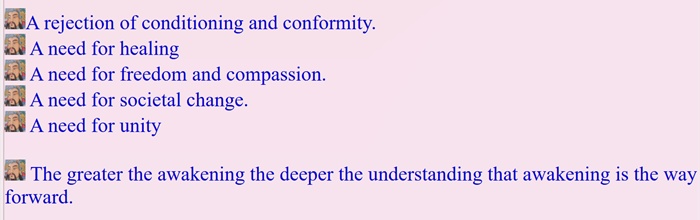
In terms of awakening, how can awakening-returning-to-community help with societal change?
zandtao has already suggested that the rejection of conditioning and conformity can lead to emotion being applied to the societal need for change, and that this emotion can be manipulated. zandtao uses the term pathtivist for the sangha who choose to bring the path to activism so this part is about the path, pathtivism and pathtivist. The pathtivist brings vision to change and activism so in this part we look at how awakening connects with change and how we see change within hegemony. In the first part zandtao suggested that bringing the awakening of compassionate liberation can be a good approach for uniting change; he highlighted the 2 egos of compassion-focus and freedom-focus suggesting that harmonious realignment of hegemony was a way forward. How does this fit in with the arena of awareness of the need for societal change?
A History of Western hegemony
Within the need for societal change there is a spectrum of approaches, and whilst spectrum suggests that change as a spectrum is continuous zandtao has already suggested that movements for change are dichotomised into compassion-ego and freedom-ego. This dichotomy has arisen within hegemony - in zandtao's view has been manipulated by hegemony. The hegemony zandtao has the best feel for is UK western as that was what he was born into so let us examine change in relation to that hegemony, and the best tools for understanding change in hegemony is seeing through the lens of history. Looking for change is relatively recent within western hegemony but we go further back to understand the western hegemony itself before addressing that change - and historically Britain has been central to the development of that western hegemony.
At this point zandtao reminds the seeker of their own spiritual duty to integrity. zandtao is presenting his own vision that connects awakening, change hegemony and history. As he has explained he works hard to ensure that his vision is as accurate as he can make it, but he does not ask that you accept it as truth. It is good to look for triggers when reading this, are you triggered into dismissing this as a trope such as left-wing marxist BS? Now remember the conditioning and conformity that was part of your life before atammayata, does any remain? Whatever triggers you - examine it. Within the inner awakening journey it was not necessary to evaluate such avoidance, when we come to examine embodiment can we accept this avoidance?
So when we consider the ditthi zandtao presents as hegemony, please mindfully grapple within a spirit of meticulous enquiry:-
Starting to see violence in hegemony
Western hegemony began in violence, it began in a time of violence and zandtao contends that to this day the hegemony continues with this characteristic of violence. In truth the west avoids seeing violence in the hegemony - avoidance that is encouraged by the Sea of Propaganda; zandtao understands but does not accept this avoidance. It is hard for western people to accept the history of hegemonic violence that provides for their comfort. The hegemony was established with violence, but not only was it established with violence but the economic fruits and prosperity of that hegemony that the West lives off was based in that violence. This avoidance is part of the patriarchal violence that is endemic to western society, a violence that is culturally accepted within the media (such as Hollywood) and is experienced by so many women on a daily basis.
Violent History
Let us historically see where this violence came from. To do this we have to unlearn the conditioning and conformity that comes from our education system. Our education system is central to the Sea of Propaganda that we are conditioned with, approaching much of what we learned in that system with unlearning discernment is required if we are to see the violence inherent in Western hegemony (for a detailed view of education read Matriellez LINK - written when bill retired early from education). At the time we are considering the earliest development of the western hegemony, the world was a violent place - as far as zandtao knows the whole world was characterised by violence to acquire wealth through land; throughout the world people were acquiring land through border and tribal violent conflict. Significant in the western violence was a change from land-based to money-led wealth. Changing from land there came Spanish gold - gold that Spanish pirates plundered from central and southern American indigenous societies. Once this gold was accumulated in Spain, the British plundered it from the Spanish; this gold was the economic base of the British Empire whose wealth was expanded as a result of plunder from their own colonial conquests.
Birth of Accumulation
Birth of Accumulation
During the time of the British Empire there was the birth of the banking and finance institutions changing the nature of Britain's wealth - although still based on gold. Finance institutions also sprouted in Europe financing other European empires - mainly British German and French. At the beginning of the 20th century immense greed (as separate empires the wealthy were already incredibly rich) within the European empires led to the 2 World Wars that ended the colonial era. These wars led to a great loss of life but not a loss of life amongst the wealthy.
Key Theme of War
Who dies in war and what is war's purpose? These world wars are spoken of as between countries - Britain and Germany, but who died? Ordinary Britons and Germans - turned into humour in Blackadder Goes Forth (S04). But what was the purpose of the war? Hegemonic. WWI was concerned with dividing the cake of Africa, it was supposedly finished with the Treaty of Versailles. Even though hegemonies were from different countries the German rich were not decimated after WW1 - this haunting lyric from Buffy Saint Marie in "Now that the buffalos gone" [1.14]:-
"Even when Germany fell to your hands, consider dear lady, consider dear man, you left them their pride and you left them their land" - what did you do to these leaders?
But Germany reemerged as fascists supported by some non-German western capital trying to profit - famously the Bush family. That is the nature of accumulation, it has no sila it goes where the profits are. WWII left most of Europe in disarray - to remerge after 20 years (characterised by the affluence of the 60s), and it allowed for the hegemonic change from colonialism to neo-colonialism - discussed next.
Birth of Current Western Hegemony
As part of their colonial expansion, in the 17th century the British colonised North America - what is now the USA. Indigenous Americans were initially hospitable to the British making the violent British model easy to implement leading to colonisation. Given the distance and lack of transport it soon became clear that these colonists need not pay tithes and taxes to the British monarchy/establishment leading to the formation of the independent US colony - note it was a different type of European colony as this independence was not carried out by the indigenous people. The US had many resources but insufficient labour to turn it into wealth. Initially they tried to exploit the indigenous peoples but they could easily escape back to their tribal homelands. So they used another British model slavery. Britain had gained wealth using the slave triangle but these European-Americans took this to a new level of exploitation establishing America as a wealthy nation.
The USA continued to develop replacing slavery with Latin wage-slavery to a position where they could establish the neocolonial era. During WWII the European colonial establishments used their peoples to destroy each other, and at a suitable point the US came in to enable "victory over the fascists". What was significant about the timing was that when they intervened the military of the European establishments had been decimated. In a sense there were 2 conquests, the victory over fascism and the conquest by the US of the European empires.
Establishing global military fear
However the US had also been fighting a war against Japan, and this war was particularly important to understand the rising US hegemony - the US used nuclear weapons establishing a global fear of how inhumanely-far the leaders of the US empire were prepared to go. Within the US hegemony developed 2 branches - the MIC and finance. Once the MIC-threat of US hegemony had been established there was less need for military troops on the ground. As colonies especially in Africa began to overthrow their colonial European oppressors but in stepped the neocolonial era of US economic exploitation. The colonial era had been characterised by a military presence of the European empires, this was then changed to modern-day finance conquistadores of corporate reps and finance institutions such as IMF, World Bank and GATT with puppet governments in situ. Throughout post-WWII the US have been involved in many military incursions to establish expansion of the neocolonial hegemony, and there are US military bases all over the world to enforce this - under the pretence of "defending democracy" amongst others. We can see this neocolonial model present in the current response of America First of the 2 Hemispheres LINK where it is recognised that America First means business first backed by the military in the Americas.
Cold War
During WWII Hitler attacked the USSR, so USSR, US and UK became wartime allies. This quickly devolved into a Cold War situation between US and USSR as NATO (formed in 1949) allies gathered to support the US. Until the fall of the Berlin wall there existed the Cold War with rhetoric of Soviet expansion but USSR saw it as a process of attempted market incursion into the USSR that had been happening since before WWII. After the unification of Germany there was no resistance to the US hegemony of neocolonialism. Whilst purporting itself as defensive there has been ongoing NATO expansion - starting from 12 member countries it is now 32, and this expansion led to the conflict between Ukraine and Russia - Ukraine having once been one of the 4 original soviets of USSR - Ukraine has been under Russian control since the end of the 18th century.
This is enough for the triggers; certainly much of this goes against the history schools give us. Firstly do not accept any of this without meticulous enquiry, yet at the same time please do not reject it because of the conditioned triggers. It is perhaps a good time now to step back and ask how relevant is this to awakening and awakening community?
And there is another significant question particularly for this part 2 how relevant is this to activism? For awakening-returning-to-community, however much of this history they accept, do we react emotionally to this injustice making demands, however legitimate, based on acceptance of this history? Is that harmonious?
With however much of this as a legitimate description of history we now need to consider how changes concerning the community has impacted. For much of this colonial history people were serfs or soldiers or slaves in service of the monarchy initially and then the rich. However unjust this slavery was, people empowered enough to fight it arose at the beginning of the 19th century. In the UK such dissent usually led to a boat to Australia, but slowly working people started asking for higher and higher wages and better working conditions. Whilst the conditions of serfs or soldiers or slaves improved, the roles remained similar - at the service of the rich (monarchy being combined with finance institutions and the owners of workplaces); the role became wage-slavery.
There was a significant analysis of these working conditions and the relationship between working people and those who paid them, and this Marxist analysis was highly important for working people seeking change from the mid-19th century until now. Marx put forward a class approach in which he dichotomised the way we viewed humanity into the bourgeois and the proletariat, what is often discussed in the UK as the ruling class and the working class. Over the last approaching-200-years people seeking change have seen themselves in the participation of a class struggle, a struggle that has a spectrum of seeking improvement without any reference to class to those seeking outright revolution as being the only way to get just reward. In an hegemony based in violence, for some violent struggle is the only solution - understandable given the milieu.
For Marxists there is a class clarity but for others it is not so clear. Much has changed since the days of serfs and soldiers and slaves, and education is key to this change. Over time there has been technological development. and within that time there has been a change in the required skills of the workforce. With industrialisation and automation and computerisation has come the need for the workforce to be more than serfs and slaves, they became educated workers, and to incentivise these workers some became small-business bosses and teachers. Serfs became the service industry - much distanced from those earlier serfs, and there has developed a caring industry. For a certain type of Marxist clarity the relationship remains bourgeois and proletarian - updated by Occupy as the 1% and 99% (percentages that do not reflect the level of accumulation in the hands of so few) - remains the filter they see as the way to implement change, yet for so many others changing circumstance has outdated this class analysis even though Marxists still cling to the dichotomy.
Insight into Hegemony
Unlearning - what to do with this history?
Sangha of autonomous path, have you managed to read all these views of the history of western hegemony? Have you experienced many triggers? Consider your own awakening process, were there many triggers as you released your conditioning and conformity? As you developed your awakening process of Unity-consciousness, did you continue to see the triggers, mindfully-grapple with them and then let go of the conditioning that gave rise to these triggers? Unlearning is part of the awakening process, unlearning is part of the process of seeing hegemony. In zeer-consciousness zandtao began by asking seekers to accept this vision of societal infrastructure, he did this because he wanted the seeker to be able to discern between conditioning and consciousness. Did that limited vision help in the process of awakening? That is the benchmark zandtao wants the sangha to take forward in building awakening community. zandtao could have begun this part 2 by asking the sangha to unlearn the way they see hegemony in the same way as unlearning conditioning and conformity is built up in the process of awakening, but zandtao wanted you to feel the triggers. He wanted you to feel the level of triggering that arises when seeing western hegemony is not avoided.
But feeling triggers and accepting truth are very different, and zandtao hopes that you, sangha, will begun to unlearn; in addon 2E zandtao will advise on this unlearning and help you develop inisght into hegemony but remember, sangha, it is all done at your pace and with the level of awareness you choose. zandtao continues to clear away the conditioning that clouds his seeing of hegemony, the Sea of Propaganda is so all-consuming; zandtao knows his vision can never be the complete tathata. But he works at it as part of his practice.
But here is the biggest question when considering this history:-
 Is this history relevant to awakening community?
If so how do we use it? How much do we use? Is our current vision enough?
In this way we are starting to gain insight into hegemony, and can decide on its relevance as we begin to consider bringing the CoA into activism as pathtivism.
So Far
So Far
For sangha reaching this far they have recognised the value in some form of Culture of Awakening - CoA, as opposed to the current self-directed waiting situation before seekers access homes of awakening. Out of their own awakening they seek to pass on compassionate liberation to all recognising that order comes through sila. The prevailing societal infrastructure is preventing this, hegemony is preventing this.
whyunlearn.jpg
For awakened there is the understanding of compassionate liberation for all and sila as the natural way for harmony, and that it is the way society is that prevents this. This gives rise to 2 questions:-
What aspects of society is preventing this change?
Is hegemony part of these aspects?
Whatever answers arise from these questions we know that essentially the way society is is preventing a change towards natural order of compassionate liberation and sila, it would be reasonable to also assume this natural order would enable further awakening by the very reason of it being the natural order. With awakening comes a desire for change, with a little further consideration that change would fit in with the natural order of compassionate liberation and sila, would further enable awakening, and by this small enquiry lead us to recognise the way society is is restricting awakening.
On a personal level we see these restrictions as attachments arising from upbringing of conditioning and conformity and societal restrictions that cause conditioning and conformity; within this hegemony must contribute to the way society is so it must restrict awakening. Therefore as part of embodiment of awakening-returning-to-community there needs to be a recognition that hegemony is restricting awakening; the question is not if but how much and our strategy concerns an approach to how much hegemony restricts. With bypassing clarity shows there is an essential complicity with restricting awakening; is it not avoidance that bypassing allows seekers to face the struggle for awakening alone without a CoA and its pillars?
3pillarsCoA.jpg
At the same time zandtao is not suggesting that this initial recognition requires an understanding of the history just presented; it took zandtao a long time to develop such insight.
Wealth
But what we have considered so far does mean that if we wish to develop a CoA, then we, sangha, need to gain insight into hegemony. When it comes to system-of-accumulation greed is clearly observable, it appears as if a numerical measurement of wealth is feeding this greed as the amounts of money some of these financial oligarchs possess far exceeds any needs for them and their families. It is quite understandable that certain activists call for redistribution of this wealth because these oligarchical families do not need nor could conceivably need that level of wealth. Where we on paths to awakening would differ from more violent activists would be consideration of harmonious ways of balance; zandtao suggests that such a violent response is born out of hegemonic ethos. There could be a more humanitarian way forward to dealing with wealth but there is entrenched division - usually based on class lines and those with wealth egoically entrench their wealth protecting it against a class that conditioning has formed in confrontation.
Class Confrontation
Based on path and awakening hegemony as it is currently understood in the West does not reflect the natural order that is understood by those awakening. The Path always talks of Unity, in zeer-consciousness zandtao speaks of Unity-consciousness. When we talk of hegemony there is an underlying assumption of division by class - hegemony as a term most recently was popularised by Gramsci, a Marxist and class is a given in Marxism. This division is supported by the rulers as a means of accepting ruler-and-being-ruled and it is accepted by some of the ruled as a means of confronting the rulers by uniting the ruled.
Historically in the West we can observe such a division and ensuing confrontation, and such a division is part of observed hegemony. But is such observed division part of natural order? Can we take lessons from the Unity of the Path, avoid such confrontation and work towards Unity? Seeking compassion for all is a way of Unity, does not draw class distinctions, and if there is Unity harmonious decisions can be made for all. It is perfectly observable to see there are those who have and others who have not, but if they are specified along class lines then there would be egoic identification with class and the rich would protect their wealth.
But if Unity were recognised would such lines be drawn? Would some who are rich choose to support others? And if that Unity were understood more spiritually then there would be fewer and fewer lines. Seeking harmony rather than aligning along class lines would be a spiritual approach - would be a pathtivist tenet of bringing path to activism.
There is much talk of the gap between rich and poor, why not talk of harmonious humanitarian development? Such harmony talks of improvement for all. As the rich start to enclave themselves their quality of life diminishes - it is not what they can buy that is destroying that quality. Change the perspective - prevailing class perspective is destructive; observe disparity but not arbitrary class boundaries.
Manipulation through class
Gramsci spoke of "soft control" - leading to the manufacturing of consent but his approach was class conscious. Such a view of consent was that the ruled somehow need to be subjugated and yet be given offerings to accept subjugation; this is far from harmonious humanitarianism. It accepts that there are those who own and give to those who receive. Spiritual Unity sees us united on one Gaia working together for improved life on earth.
Egoically the egos of the ruled see their struggles as gaining them victories yet the rich within the system-of-accumulation benefit from these struggles as they are getting richer. Despite the intentions of the 99% (99.9%) their struggles increase the wealth of the 1% (0.1%). But if they were not struggling against each other, if the system-of-accumulation was not putting profits first then perhaps a focus on harmonious humanitarian path would lead to better quality for all.
Current Hegemonic Governance
Western democracy broadly reflects these class lines confronting employers with workers and not-employed. Whilst within electoral delusions there are often alternatives governance historically reflects this increasing benefit for the ruling class. Whilst they claim governance for all it can be observed that even though governments might change within these electoral systems overall governance within system-of-accumulation increases the wealth gap. Such governance is not primarily harmonious humanitarian progress but a maintaining of the status quo of the current economic system yet the basis of the current economic system is a system-of-accumulation thus perpetuating and increasing the wealth gap.
It is clear that for many people there is acceptance of such a status quo - consent, but this acceptance is based on a delusion that such economic governance to a lesser or greater extent is that maintaining the current economic system is beneficial for all.
Delusion
Gramsci and others described hegemony as manufacturing consent but spiritually the path would be more succinct - governance and hegemony creates and maintains delusion. Most people within the western hegemony have been deluded into accepting that the western democratic model as the best form of governance. It is based in compassionate liberation and it purports to give people the choice of government and in that choosing there will be the greatest compassion. Whilst in principle this might be the case, the reality is increased division, increased polarisation of wealth, and the lack of harmonious humanitarian advancement. But governance maintains delusion, politicians are often criticised for lying without the people realising that such lies are part of the hegemonic delusion. With awakening comes truth and the perception of truth and truth-telling, whether by choice or not hegemony discourages awakening.
Sangha, does this questioning give you an insight into hegemony. By measuring hegemony against path and awakening we can see that hegemonic weaknesses that restrict the natural order of sila from the path of compassionate liberation - developing harmonious humanitarianism. Out of an examination of hegemony in light of the path we find that the path by nature works against prevailing western hegemony:-
Wealth
Class Division and Confrontation
system-of-accumulation
Delusion
Causality
Causality is a good way to get an insight into hegemony - let me discuss causality and its relationship with consciousness. Maths is maybe a good way to understand this relationship. Let us consider mathematical development. It starts with axioms - supposedly fundamental indisputable rules that cannot be broken down further. From those axioms mathematical logic takes those original axioms further into different conclusions that can then become new starting points - accepted as new axioms, conclusions or corollaries. In addition there are patterns that appear in different branches of maths - known as isomorphism. Start with a different axiom develop through mathematical logic and there is a different branch of maths isomorphic to the first.
Now let us consider problem-solving - the essence of being a true mathematician. A problem is not described mathematically, a problem is written in plain everyday English (plain language). The mathematician attempts to "fit" this problem into one of the many isomorphic patterns that make up maths. Eventually this creative mathematician grapples (mindfully) with the everyday problem until s/he comes up with an insight that functions as an axiom that mathematical logic can develop and come up with a conclusion. The essence of the good mathematician is the insight, not the mathematical logic or processing. (This also places AI clearly in the universe, however much investment. The AI can only process, humanity provides the insight; processing is quicker by AI but it cannot begin without humanity. If this relationship is not emphasised there are great risks with possible exploitation through AI.) This mathematical relationship shows the relationship between consciousness or conscious insight and processing or reasoning.
Out of consciousness arises insight that directs reasoning. Broaden this consciousness and we have innumerable insights directing reasoning in daily life. So using the mathematical metaphor the consciousness of good mathematicians is applied through reasoning to build up the totality of mathematics, coming out of metaphor we have the insights of consciousness sparking and directing the totality of causality. Insights do not exist separately, they are processed or lost; that is direction or intention. zandtao contends that causality simply continues, processing is ongoing (similar to thought). Let him take that further. We live within a milieu of causality - ongoing processing - that zandtao has called conditioning and conformity. This causality has no direction, it is ongoing causality that just happens naturally but it can be impacted. (This notion arises from Buddhism and is connected to that - discussed in Addon 2F).
As part of awakening, sangha, zandtao suspects you already have insight into causality. Awakening is a conscious intention that takes the seeker beyond causality into a state of atammayata. This process recognises that there is a need for this conscious intention to build awakening to go beyond the clinging to ego and dukkha - bringing in consciousness to release restrictions:-
zeer/2themes
Causality has its own egoic direction through attraction. Ego survives and builds attachment to itself, this process is just the way ego is - unless there is conscious attention ego will survive, attach and build; hence the need for conscious intention to go beyond ego - beyond attachment - beyond causality. Here is the problem with the bypassing of awakening only. Given that existing embodiment is primarily teaching towards awakening, what is happening to the egos attracted to power and influence - egos building hegemony? There is limited specific seeker-embodiment process of releasing hegemonic egos because the focus is on awakening and awakening experiences and not embodiment; the awakening process has limited impact on the egoic power and influence of hegemony .
Hegemony comes out of the egos focussed on power and influence; what has been suggested so far is that awakening does not work to go beyond hegemonic egos. Of course such egos are very strong (narcissistic) to become leaders in an egoic societal structure, and the path of releasing ego is necessary within hegemonic ego as well as within the awakening process in wider society.
But given the power and influence of hegemony perhaps forces for change within hegemony are sufficient. That is the pathtivist approach, bring the path to activism. Out of awakening comes the need for embodiment and the need for change, can such paths enable hegemonic change by working within the hegemony? That is the pathtivist proposal- to bring the path of compassionate liberation to grassroots activism.
Activism and Pathtivism
Pathtivism - What is a pathtivist?
A pathtivist is a seeker following their path who chooses grassroots activism as their embodiment. As far as zandtao knows pathtivism/pathtivist are words he has coined so such a description cannot be refuted. Pathtivism has huge implications for the seeker and for the grassroots movement itself.
Let us examine what zandtao means by seeker. In zandtao’s terms a seeker following the path could be anyone who is developing a practice and who is working through similar to what zandtao has described in chapters 1 to 5 of zeer-consciousness including unleashing love through the two best books of Nicola Amadora "Love Unleashed" and/or Teal Swan "How to Love Yourself" as indicated in Ch5.
Where is the path in activism?
Our paths are Nature’s way of telling us about how to be compassionate and liberated. Within this compassionate liberation paths also give us nature’s blueprints for action, as we learn about ourselves this blueprint leads to wise embodiment and action as an imperative. Yet where is the evidence of this path imperative in grassroots activism? Indigenous peoples identify path with their actions - perhaps because of a cultural connection and because their connection with Nature is under threat from the societal infrastructure that is western life. Yet as western sangha and seekers finding our paths how much emphasis do we place on activism?
Western life lacks connection - lacks Unity-consciousness, and the love and wisdom that arises from our paths does not seem to take us to active change. We recognise there is a need to change but conscious embodiment is lacking. Instead western movements for change are not guided by elders on the path; instead they arise through idealism and emotional reactions to upbringings - all part of a destructive hegemony and patriarchal system.
How can the path be absent from activism? As awareness grows in new seekers, they start to know that there is a need for change; but in our current limited Culture of Awakening where is the direction that seeks social change? To begin with there is awareness of developing consciousness, and this search for purpose tends to focus on developing wisdom. There might then develop a love-wisdom balance - equanimity, but does that equanimity lead to activism?
For all following the path there comes some kind of Unity-consciousness with Nature, but where is embodiment of this consciousness in grassroots activism? When we examine western society for leaders in the movement for change - for Unity-consciousness with nature, we might see an autistic Swedish schoolgirl as a leader. Lifelong political activists might be angered by youthful derision as to what older people have done to fight exploitation, but where is the path amongst those older activists? Greta’s critical derision can legitimately be applied to the spiritual movement who have not been active within struggles, and when we examine grassroots movements we see such immaturity and lack of progress because the path has not been involved. Where is the conscious activism?
In this second part of Awakening Community zandtao will be examining the path imperative for embodiment in grassroots activism. There is a certain dishonesty in zandtao's pathtivism. Whilst he considers himself as having been an agent for change throughout his life, apart from a short while in the 80s and 90s that agency was not in the grassroots movement. Yet zandtao has no doubt that humanity's failure in grassroots activism is a significant reason for the increasing social impact of worsening hegemony with its authoritarian demagogues. zandtao is asking for path embodiment within grassroots activism - however uncomfortable might be the egos to be found there.
zandtao wishes to pay tribute to grassroots activists who have significntly but unconsciously found an egoless path within this activism. Can sangha and seekers who have been fortunate to consciously find their paths direct their embodiment imperative to grassroots activism? Can we cope with the quagmire of egos to be found there? Can we find a harmonious way of change to promote human development - a harmonious humanitarianism? Hopefully the harmony presented through pathtivism can help.
Seeking
Broadening out the understanding of what is a new seeker, it would be someone who has started on an inner journey. Let zandtao briefly place that in context. Through our upbringing we learn conditioning and conformity to fit in with society - get a job etc. But fitting into societal infrastructure can for many people be a conformity that is too much for their own journey within human infrastructure. As such a seeker can extend their societal journey by broadening through travel and/or they can begin to look inwards for answers. Seeking can be an oscillation between the inner and outer journey throughout their lives with varying results. This is where pathtivism fits in, pathtivists choose grassroots activism as outer embodiment. In this part of Awakening Community, zandtao will be discussing how to bring the path to grassroots activism - online blogs concerning pathtivism is presented as zandbagging  .
Let us step back a little in terms of the seeker’s journey. At some point in their journey a seeker’s life might well be rocked by awareness, awareness of conditioning and conformity is not really easy. Especially in his zandtaomed trilogy, zandtao refers to upheaval - his own “rocking”. Coming to terms with the implications of this awareness then becomes the seeker’s journey throughout their lives, and it is this journey that oscillates between the inner and outer. Throughout the book on zeer-consciousness zandtao describes how the inner journey could unfold leading to conscious loving and evolving of consciousness - based on his own experience.
Starting embodiment
But zeer-consciousness does not include interaction with the outer. When awakening starts to rock, relationship with daily life is permanently altered. For most people whose awareness has been rocked their life changes to a spiritual life of following the path - whichever way is chosen; Batgap has many examples of seekers whose awareness has rocked their lives and the spiritual choices they have then made. For most of these spiritual people their outer journey is taken up with “passing-on” - incumbent to recognising and following the path comes a natural duty to pass on. When considering the survival aspect of the path - eg food and housing - such seekers will say that the path takes care of itself and material needs get met; zandtao has no reason to dispute this.
But now comes the big question to seekers - the essential aspect of this section of thezeer. What is your embodiment? After awareness has rocked the seeker’s life they reach a compromise with daily life and their lives settle down; awareness-rocking-lives cannot be a permanent aspect of their journey - even though insights might continue to rock life to a lesser extent. At some stage along their journey their inner-outer oscillation begins to ask about embodiment - how best can we give back? It appears to zandtao that increasingly teachers are asking about embodiment, is that impression true?
Going with the embodiment question zandtao now asks:-
What are seekers choosing as embodiment?
It appears to zandtao through listening to Batgap and others that most seekers work up to being teachers-of-sorts and this is their embodiment. Batgap interviewees have their websites and offer teaching - none of which zandtao has any significant disagreement with; there are many paths and practices. But few of these “Conversations With “Ordinary” Spiritually Awakening People” discuss grassroots activism as their embodiment. For all there is a component of returning to the natural path and the need for societal change, but it appears that in most cases this component does not lead to embodiment within grassroots activism.
Isn’t grassroots activism the arena for change?
And no wonder!! Grassroots activism is ego-hell, and as a struggle is increasingly being “defeated” within the societal infrastructure. Yet isn’t grassroots activism the milieu for change? Isn’t grassroots activism the arena for activism for the environment? What did Greta achieve? Watch this 2 minute clip - “Kids for Climate Justice”. Every time zandtao watches this clip, his heart sings at the youthful concern, and then his compassion sinks at the effective lack of systemic response. Yet those kids are only calling for what the path wants - path embodiment.
What has happened to activists inspired by Greta’s grassroots movement? Their activism has become increasingly frustrated, increasingly destructive towards the societal infrastructure, and eventually the system has manipulated this activism into being considered criminal - and the activists are being imprisoned. Imprisoning grassroots activism is not new or unusual, and is an effective tool of the societal infrastructure to maintain the accumulation of the rich.
Our system is arresting activists who in a certain way are standing up for what the path wants - nature and climate action. What seeker would not agree with what is written here:-

This is taken from the extinction rebellion site; zandtao thinks XR grew out of Greta’s kids and are often the activists being imprisoned. Since the time of Greta’s inspiration grassroots activism has failed and the frustration at that failure has led to imprisonment. During that time there appears to have been no effective wise embodiment of nature’s path.
As a spiritual person zandtao laments this failure. He knows he had no involvement but he knew then and he knows now there is a need for the path as wise embodiment in grassroots activism. That is and the premise of this part II of  . How can seekers go through all the path and practice leading to consciously loving and evolving consciousness yet the people fighting for our planet are imprisoned?
As seekers we are not addressing this activism dilemma - presumably because it is so hard. zandtao calls on sympathetic seekers to become pathtivists to address this dilemma, to bring wise embodiment to grassroots activism. At the beginning of this chapter zandtao described pathtivism as having “huge implications for the seeker and for the grassroots movement itself”. Wise embodiment is not asking for seekers to become imprisoned but he is asking for wisdom to be brought to grassroots activism.
Hypothetically what could have happened? Following Greta’s inspiration the youth movement guided by wisdom would have found a way of changing the societal infrastructure so that the crisis of “Life on earth” would have been averted. Instead activism was squeezed as 99%-apathy didn’t step in, and eventually the frustration was manipulated into criminal acts (from new and old laws). Where was path-wisdom in this process?
Through zandtao nature is asking:-
Do we need to effect changes in the societal infrastructure, and if so how?
Is what we are doing so far sufficient as wise embodiment?
Is grassroots activism where we could be using wise embodiment?
zandtao knows that following the path is hard enough - having said that it is not as hard as not following the path either with awareness or in “ignorance”. As part of following the path there is embodiment, and each seeker needs to make a decision concerning their own embodiment. For the rest of this section zandtao presents his bag - making the choice of embodiment in grassroots activism.
Choice of Grassroots Activism
What do we do with wise embodiment in grassroots activism? This is a far-from-easy question. Let us start with some path principles within pathtivism, but before zandtao does that remember:-
A seeker’s priority is to follow their path, how they manage their embodiment is secondary to this.
Following your path - holding to your path - is a daily need for the pathtivist. Particularly in terms of grassroots activism walking the path is a tightrope where the pathtivist will need such a strong conviction to overcome all the conditioning factors that will come to bear during activism.
Pathtivists will need to use the 2 aspects of practice as described in Ch5:-
Holding to consciousness
Releasing restrictions
Path Principles - PP
There are certain graces of consciousness which have particular application when working in grassroots activism:-
Truth
Harmony
Peace
Compassion
Transcending/atammayata
Wise embodiment
Together with the practice of releasing restrictions that arise from within activism, having a deep sense of clarity about these graces helps to maintain balance as an activist. All of these path principles intertwine so it is difficult to decide how to present the use of these principles wisely, yet with the increasing complexity of working as a grassroots activist we have to hold to these principles. In Addon 2G zandtao has considered uses of these Path Principles but what is more important is the examination of activism itself - hence as Addon 2G.
At this point zandtao wants to refer to authority to highlight the need for embodiment - the authority of Gabi Kovalenko. Working with gabiK especilly in Ch5 helped us understand consciousness and the purpose of the path - consciously loving and evolving consciousness. In her book LINK she looks at embodiment bringing the following attributes to activism. In Addon 2I LINK zandtao discusses these attributes and in Addon 2H LINK zandtao gives his own approach to channelling and acceptance of Gabi Kovalenko. zandtao has pointed at this channelling so that the reader can determine and assess with their own mindful grappling; as zandtao points out in Addon 2H there can be dangers with channelling and his resolving is the Kalama sutta - don't believe anything it has to be your truth.
Here are the attributes from gabiK:-
LIST
Combining these with the Path Principles (path has many other graces and attributes) enables sangha or seeker to start embodiment in the world of grassroots activism.
Call to Pathtivism
Grassroots Rallying Call
Replacing “this book” in the last gabiK quote with pathtivism or following the path is the same rallying call that zandtao as pathtivist would shout out. But for zandtao the emphasis for pathtivism is different because his rallying call is directed at seekers looking towards a collective journey that includes embodiment in grassroots activism.
Divided by ditthis
When it comes to activism activists focus on a cause whether it is the grander class change or a particular focus such as oxycontin and the Sacklers (see movie Dopesick). Usually activists demand a perspective from each other - typically a Marxist perspective (even though within activism there is a markedly different understanding of what Marx wrote). Essentially this perspective could be considered a ditthi, and usual activists demand a particular ditthi (ditthupadana).
In non-Buddhist terms activists demand of each other to believe a perspective or set of ideals or a system or an ism, and encumbered in this demand is a level of division when there is not agreement as to the system (or ditthis). Especially amongst groups of Marxists there is a sense that activists should believe in certain Marxist ideals, work together in a certain way, and failure to do so indicates a level of lacking commitment. Inherent within this type of activism is division, and considering the power and influence of accumulation such divided activism creates potential downfall.
Pathtivists develop themselves and build activism
For pathtivists the emphasis is not on the cause or the system, the emphasis is on personal development whilst embodying natural duty as activism and the building of social activism. Very few people in general dispute that there is no need for change, but dispute arises as to how. Within that dispute there might arise the ego that there is nothing that can be done, or with others my cause is more important than your cause, or with some your cause is not valid because of the organisation your cause is in (eg Marxists not working with religious activism on social inequity).
The commonality for pathtivists is not the cause that they are active in nor is it a system of ideals, it is however a focus on ongoing personal development the consequence of which is some form of embodiment through societal activism. A chance meeting between seekers might be - how is your practice developing and what are you active in now? In such an approach there is no separation within compassion. Compassion gives rise to a particular cause based on the individual’s upbringing and lifestyle, the personal development of a pathtivist will lead to organisational skills, and the individual pathtivist will then be a valuable activist for that particular cause.
Pathtivism - Path and Time
Pathtivists would then balance their time as to their own personal development and commitment to the social activity - whilst also having to earn money to live (and feed family?). There is an unwritten assumption amongst most activists, they believe that they have seen through conditioning - even if they don’t call it conditioning. The left and right swap insults such as sheeple in which their own disunities talk of the other not seeing the way they are programmed. From bill’s experience the left did not throw off their conditioning, they threw off some of the conformity of their upbringing. But once they were aligned with a particular leftist cause they failed to develop personally, and did not further explore and release the conditioning and conformity of their upbringing. Rather than the reaction to conformity being a starting process in transcendence (atammayata - PP) - the end of being conditioned, these leftists remained conditioned to a significant extent demonstrating this conditioning process by becoming attached to a particular systemic view and the way to challenge it.
zandtao has observed this on the left so can talk of it from that experience. With regards to the right he has no experience but does not view their adherence to views as being beneficial. Neither of these left nor right activists are working towards unity, at best the left are working towards a unity so long as all believe a particular doctrine (ditthi). It is not compassionate to expect all to believe the same, and it is also not natural to demand of others that they believe what you believe. People must follow their own path, and if we show tolerance there is a process towards unity. And rooted in that tolerance for pathtivists is the understanding that nature’s paths will bring compassion, unity and harmony.
Paraphrasing gabiK, pathtivism will be "a journey facilitating your evolution, my dear reader. I encourage you to surrender to your own heart as you take in these words, feel the energy of these intentions, and allow them to infuse your spirit with more faith, acceptance, and love so that you can embrace all of life's challenges challenges as gifts, bringing you into closer alignment with your own soul and its sacred purpose along our collective journey". Within the life of a pathtivist, challenges would involve social activism and a cause to produce change. Trust in the soul means that there would be inherent discernment concerning the cause for change, and attributes such as feel the energy of these intentions, and allow them to infuse your spirit with more faith, acceptance, and love will provide the strength and vitality to help change the societal infrastructure whilst at the same time building unity amongst activists. However it works out for an individual seeker, the embodiment is activism, the approach is path principles to build unity and harmony in their embodied grassroots activism.
Before we can find a way of harmony and apply pathtivism and path principles we need to have some understanding of the state of activism. And then based on that understanding look towards more people activating in order to effect change.
Ch2 /Contents/ Ch4
|